Highest CPC AdSense Keywords in 2026

The durable high-CPC verticals — insurance, legal, loans, mortgage, SaaS, finance, and AI tools — still pay well, but AI Overviews have cut organic traffic to many informational pages, so CPC alone no longer guarantees revenue.
Every Wednesday. 28,400+ operators. Zero fluff.
✓ Check your inbox — click the confirmation link to complete sign-up.
✓ You're subscribed!
✓ You're already on the list.
Updated for 2026.
Making money with display ads in 2026 is a different game than it was even two years ago. The basic economics are the same: advertiser CPC is driven by how much a company can pay to acquire a customer. An insurance company can afford to pay hundreds of dollars per click because a new policyholder is worth thousands over a lifetime. A news blog about celebrity gossip gets pennies.
What has changed is the traffic side. Google’s AI Overviews now appear on roughly 60% of US informational queries, and multiple studies (Ahrefs, Authoritas, others from 2024–25) show organic click-through rates dropping 15–30% on queries where an AI Overview is present. If you are running a pure-informational content site that relies on high-volume, mid-funnel searches, your traffic equation has likely gotten harder — regardless of your CPC.
So the 2026 playbook is: pick a high-CPC niche AND produce content that earns clicks in an AI-heavy SERP — meaning genuine depth, personal experience, or commercial/transactional intent that AI Overviews don’t fully satisfy.
That second half is its own discipline: getting your content cited inside the AI answer instead of buried beneath it. I’ve written the practical version in what generative engine optimization (GEO) actually is, and it’s the core of my GEO consulting work — if AI Overviews are eating the traffic behind your best-CPC pages, that’s the lever to pull.
The highest-CPC AdSense niches for 2026 (by vertical)
These are the consistently high-CPC verticals. The numbers below are rough illustrative ranges — actual CPCs vary widely by keyword, geography, competition level, and timing. Treat them as order-of-magnitude guidance, not guarantees.
- Insurance — among the highest-CPC verticals; auto, health, and life insurance keywords routinely command $40–$80+ per click in competitive US markets
- Legal / Attorney — personal injury, mesothelioma, and car accident attorney keywords are famously expensive; $50–$600+ depending on locality and case type
- Loans & Mortgage — refinance, home equity, and personal loan keywords are in the $30–$80 range
- Finance / Investing — wealth management, financial advisor, and trading platform keywords pay well; crypto-related keywords remain high but volatile
- SaaS & B2B Software — CRM, ERP, HR software, and project management tools; companies with high contract values bid aggressively
- AI & Automation Tools — a newer high-CPC entrant; enterprise AI platforms, automation software, and “AI for [industry]” keywords have climbed sharply since 2023
- Online Education / Degrees — accredited online degree programs, MBA, and professional certifications are consistently high-CPC
- Web Hosting & Domains — managed hosting, enterprise hosting, and cloud infrastructure keywords
- Medical / Health Services — treatment centers, clinical trials, and specialist referral keywords
- Energy / Utilities — home solar, electricity comparison, and energy efficiency keywords in deregulated markets
Why do these niches pay so much?
The same reason they always have: business economics. A personal injury law firm that wins a case may collect 33% of a seven-figure settlement. Paying $500 per click to acquire a case that nets $300,000 is a great trade. An enterprise SaaS company with $50,000 annual contracts can pay $100+ per click all day. The ad auction reflects lifetime customer value.
The 2026 reality: CPC × traffic × intent
Here is a framework I use now when evaluating a content opportunity for ad revenue:
Expected revenue ≈ Traffic × CTR × CPC
All three variables matter, and AI Overviews have compressed the middle term (CTR) on informational queries. Content that earns clicks despite AI Overviews tends to have one or more of:
- Transactional intent — the searcher needs to buy or contact someone (comparison pages, “best X near me”)
- Personal/expert experience — a real practitioner’s take that AI can’t fully replicate
- Recency — breaking news, up-to-date data, or current pricing that AI Overviews may not have
Pure definitional content (“what is mesothelioma”) is now largely answered in the Overview. The more interesting target is the next-step query (“mesothelioma attorney california reviews 2026”) where the searcher still wants a human resource.
Which AdSense ad formats pay the most?
From my own experiments across multiple sites, native in-article ads consistently outperform sidebar and banner placements on click-through rate. They blend with content and appear at natural reading pauses.

Sidebar ads are the weakest placement — users have developed strong banner blindness for anything in a fixed sidebar column.
Matched Content works well if you have a deep archive and want to increase pages per session. More pages = more ad impressions.
Auto Ads and AI-driven placement in 2026
Google’s Auto Ads have matured considerably. The machine learning behind placement decisions now factors in scroll depth, device type, and per-page engagement signals. My current default is to enable Auto Ads and let Google’s models optimize, then use Blocking Controls (see Bonus #2 below) to prune categories that drag down effective CPC.
Google has access to billions of page-and-ad combinations. Unless you have a strong intuition based on your own data, their placement models will likely outperform manual placement.
High-CPC keyword tables (illustrative data)
The tables below use data from prior SEMrush studies and historical reporting. These are meant to show the shape of CPC distribution within each niche — which keyword types command a premium and why — not to be used as live bid guidance. Actual CPCs shift monthly.
Mesothelioma keywords — CPC profile
Mesothelioma is a cancer caused by asbestos exposure, predominantly contracted at job sites. Victims have legal claims worth millions, so attorneys compete aggressively for this traffic. The CPCs below are historically among the highest in any vertical.
| Keyword type | CPC range (USD) | Why it pays |
| mesothelioma compensation / settlement | $250–$580 | High-value legal claim, limited viable plaintiffs |
| mesothelioma attorney [city] | $350–$580 | Local intent + irreversible case assignment |
| mesothelioma law firms | $200–$400 | Top-of-funnel for legal representation |
Ranking for these keywords means competing with WebMD, Mayo Clinic, and major law firm SEO machines. Realistic entry point unless you already have domain authority in the legal or medical space.
Lawyer / personal injury keywords — CPC profile
| Keyword type | CPC range (USD) | Notes |
| car accident lawyer [city] | $350–$600 | Hyper-local; CPCs vary dramatically by city market size |
| truck accident attorney [state] | $250–$500 | Higher damages = higher advertiser bids |
| personal injury attorney [city] | $200–$575 | Broad but competitive |
Attorney keywords — CPC profile
| Keyword type | CPC range (USD) | Notes |
| personal injury attorney [city] | $300–$575 | Same economics as lawyers — "attorney" vs "lawyer" has distinct SERP profiles |
| accident attorney [city] | $250–$550 | Local modifiers drive much of the variance |
| motorcycle accident attorney [region] | $200–$475 | Niche but high-value cases |
Insurance keywords — CPC profile
The insurance vertical is the most accessible high-CPC niche for independent publishers because there is genuine informational content to write — comparisons, explainers, state-specific guides — that still earns clicks even in an AI Overview environment.
| Keyword type | CPC range (USD) | Notes |
| compare car insurance | $150–$470 | High intent, comparison content performs |
| car insurance comparison quote | $150–$350 | Transactional; AI Overviews less likely to satisfy |
| insurance quotes [demographic] | $100–$300 | Young drivers, new drivers, etc. are sub-niches |
| auto insurance [city/state] | $100–$420 | Local intent is strong here |
SaaS & B2B software keywords
This is the niche I find most interesting for 2026 because it intersects with my own work building AI agent systems. Enterprise software buyers are worth $50K–$500K+ in ACV, and the companies bidding for these clicks know it.
| Keyword type | CPC range (USD) | Notes |
| CRM software for [industry] | $30–$120 | Specific verticals command premiums |
| HR software comparison | $25–$100 | Comparison content is strong in SaaS |
| AI automation tools for [use case] | $20–$90 | Fast-growing CPC category since 2024 |
| fitness management software | $40–$80 | Niche B2B with real commercial intent |
Online education keywords — CPC profile
| KEYWORD TYPE | CPC RANGE |
|---|---|
| Online accredited degree programs | $80–$140 |
| Online MBA / business degree | $80–$130 |
| Online psychology degree | $70–$135 |
| Online healthcare administration degree | $70–$120 |
| Professional certification courses online | $40–$90 |
Digital marketing / SEO keywords
For readers of this blog, these are the most actionable — content you can legitimately write from experience.
| Keyword | CPC range (USD) | Notes |
| seo explanation / what is seo | $40–$110 | Foundational; AI Overviews heavy but still drives traffic |
| digital marketing degree / certificate | $60–$100 | Education intent = high CPC |
| seo company / seo services | $40–$80 | Commercial intent |
| online marketing courses | $50–$95 | Steady demand, AI can't replace course comparison intent |
Crypto / Web3 keywords — CPC profile
Crypto CPCs are volatile and closely track market sentiment. In bull markets they climb significantly; in bear markets they compress. Informational crypto content is also heavily saturated.
| Keyword type | CPC range (USD) | Notes |
| bitcoin merchant services / account | $20–$65 | B2B intent; more stable CPC than retail crypto |
| how to invest in bitcoin | $10–$30 | High volume, lots of competition |
| crypto trading platform comparison | $15–$50 | Commercial intent is stronger here |
Don’t see your industry?
Head to SEMRush → Keyword Analytics > Phrase Match, type your seed keyword, then sort by CPC. That gives you the real landscape for your niche. More keyword research techniques here.
Table of contents
Open Table of contents
- Bonus #1: Target these countries for higher RPM
- Bonus #2: Raise effective CPC by blocking low-paying ad categories
- Bonus #3: Find competitor keywords worth targeting
- Bonus #4: Find high-CPC opportunities in your existing Search Console data
- What does it take to earn $100/day with AdSense?
- Tips for YouTube CPC
- High-CPC AdSense Keywords — 2026 FAQ
- What changed in 2026
Bonus #1: Target these countries for higher RPM
Geography matters enormously. US-targeted traffic commands the highest average CPCs and RPM. Here are rough benchmarks:
| Country | Avg. CPC range | Notes |
| United States | $0.40–$2.30 avg; $50+ on premium keywords | Highest overall; premium niches are far above average |
| Canada | $0.50–$2.00 avg | Close to US; similar advertiser pool |
| United Kingdom | $0.10–$1.60 avg | Strong for finance and legal |
| Germany | $0.40–$1.00 avg | High RPM; write in German for best results |
| UAE | $0.15–$3.10 avg | High CTR market; finance and real estate pay well |
| Australia | $0.30–$1.50 avg | Punches above its weight on CPC |
The easiest way to target a specific country is to write in the country’s primary language and build content around locally-specific queries (state/city-level insurance, local attorney keywords, etc.). You can also use Search Console’s International Targeting settings.
Bonus #2: Raise effective CPC by blocking low-paying ad categories
AdSense lets you control which ad categories appear on your site. If a category is consuming 5% of impressions but only generating 1% of revenue, blocking it forces the auction to fill those slots with higher-value bids.

Steps:
- Go to AdSense → Blocking Controls > Content > All Sites
- Click General Categories
- Sort by % Earnings (ascending) — categories with high impression share but low earnings share are your targets
- Block the worst performers and monitor for 2–4 weeks
Caution: Block too many categories and you reduce auction competition, which can lower your effective CPM. Run controlled experiments (see below) rather than bulk-blocking.
Run Optimization Experiments
Under Optimization > Experiments you can A/B test blocking decisions. Google runs the experiment for 10–100 days (depending on traffic) and tells you whether blocking improved revenue. This is the right way to make these changes — data over intuition.

Bonus #3: Find competitor keywords worth targeting
Want to see which keywords are driving revenue to competitors in your niche? Here is the process I use with SEMRush:
- Find 3–5 authoritative sites in your target niche
- Paste the domain into SEMRush’s search bar
- Go to Top Organic Keywords → See Full Report
- Sort by CPC (descending)
- Filter for keywords where you can realistically compete (KD under ~60 for newer sites)
- Repeat across all 3–5 sites, then consolidate into a spreadsheet

After doing this for 3–5 sites you will have a solid keyword list that you know is already generating revenue for someone — you’re just validating demand before writing.
Bonus #4: Find high-CPC opportunities in your existing Search Console data
You probably already rank for some high-CPC keywords without fully targeting them. Here is how to find them:
-
Install the Keywords Everywhere Chrome Extension
-
Open Google Search Console → Performance → Search Results
-
Check all four boxes: Clicks, Impressions, CTR, Position

-
Filter to a specific page you want to optimize
-
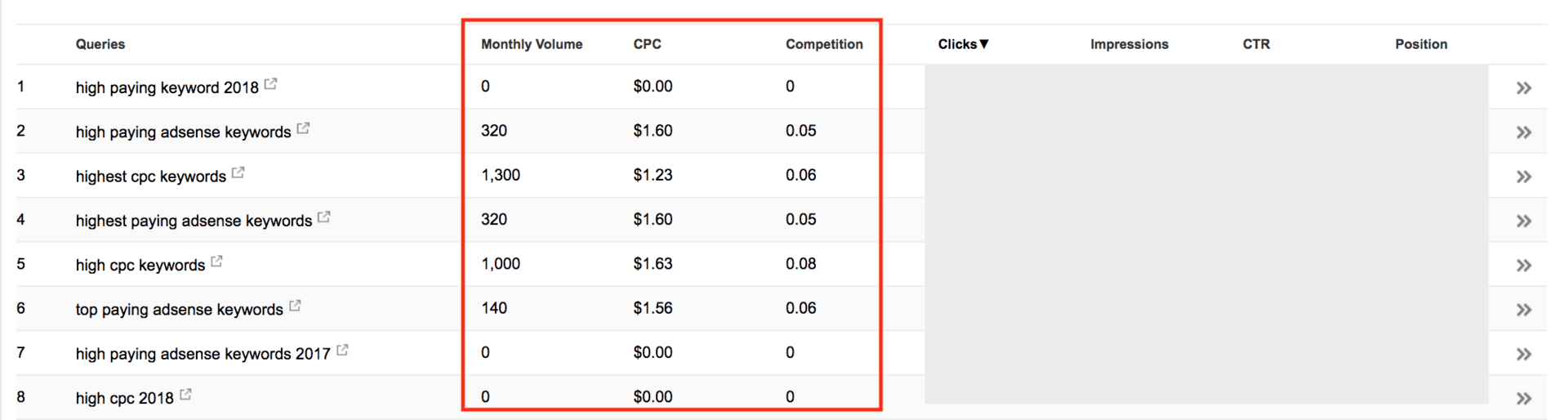
Keywords Everywhere adds CPC, Volume, and Competition columns inline
-
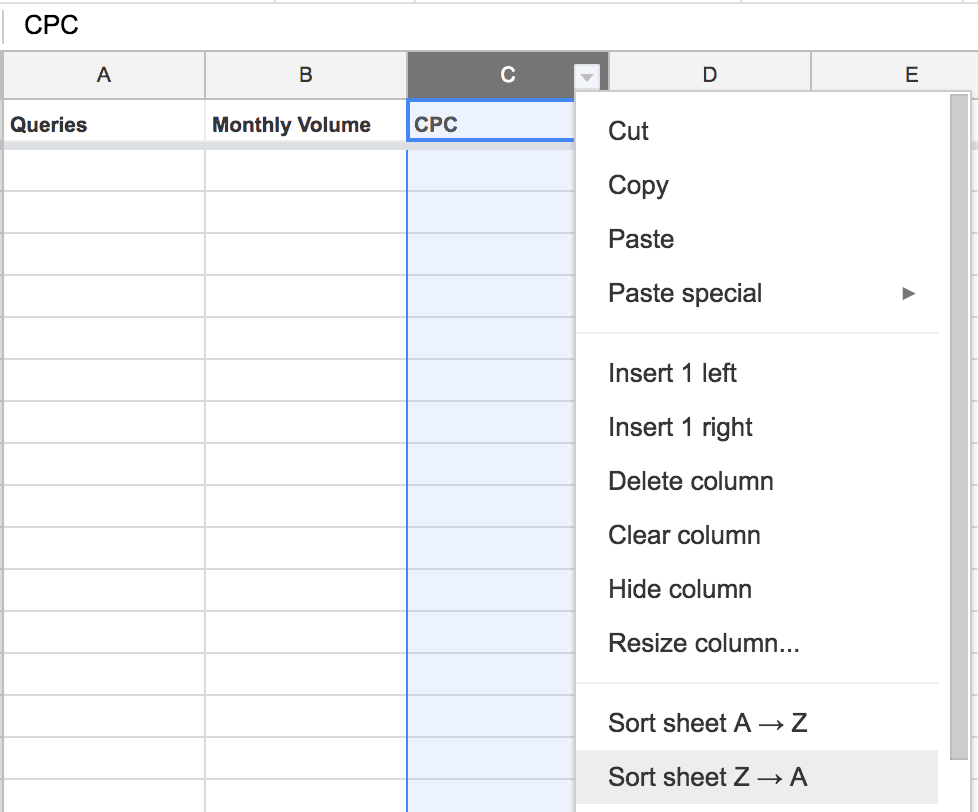
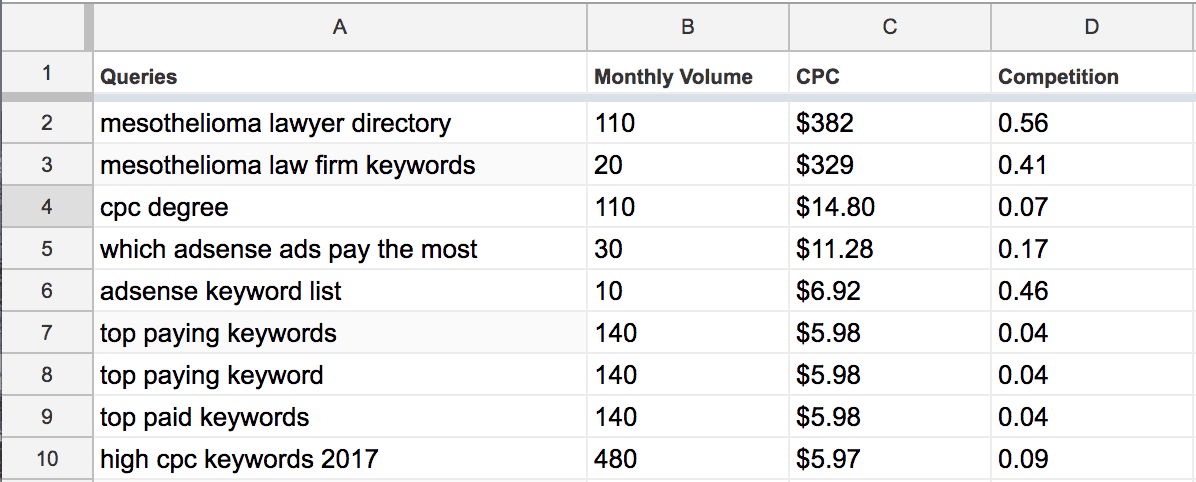
Export to a spreadsheet and sort by CPC descending
-
Use this Google Sheet template to sort by CPC (column Z→A)
-
Look specifically for high-CPC keywords where you rank positions 5–20 — those are pages worth expanding to push toward page one


This approach compounds your existing work rather than starting from scratch. Extending an existing post to more comprehensively cover a keyword it already ranks for is typically faster than writing a new post from zero.
Note: since Google’s RankBrain and Helpful Content updates, targeting topically-related medium-tail keywords performs better than narrow keyword stuffing.
What does it take to earn $100/day with AdSense?
$100/day is $3,000/month — a reasonable passive income target for a niche site. Here is the math under conservative assumptions:
- Audience: US readers (highest average CPC)
- CTR: 1% (1 in 100 visitors clicks an ad)
- CPC: $0.50 (modest niche, early-stage site)
- RPM: $2
Formula: Visitors × CTR × CPC + (Visitors / 1,000) × RPM
At these numbers: 15,000 daily visitors → ~$105/day
15,000 daily pageviews is achievable via:
- 15 posts each earning 1,000 views/day (harder — requires strong individual rankings)
- 150 posts each earning 100 views/day (more realistic — broad coverage of a niche)
The second path is more durable. Learn how to write articles that attract organic traffic.
Tips for YouTube CPC
The same niche logic applies on YouTube. Insurance, legal, finance, and SaaS content performs well because advertisers in those categories buy YouTube placements too. Include your target keywords in your video description — YouTube’s algorithm uses it for relevance matching.
More: YouTube SEO tips.
High-CPC AdSense Keywords — 2026 FAQ
Does CPC still matter in 2026, or has AI Search broken the model?
CPC still matters — advertiser budgets in insurance, legal, and finance haven’t shrunk. What has changed is that AI Overviews absorb a meaningful share of organic clicks on informational queries, so your traffic-to-revenue conversion requires content with real transactional or experiential value. High CPC + strong commercial intent = still very viable. High CPC + pure informational “what is X” content = diminishing returns.
Which high-CPC niche is the most accessible for a new publisher in 2026?
Insurance comparison content and SaaS/software comparison content are two accessible entry points. Both have genuine informational depth to offer (state regulations, pricing nuances, feature comparisons) that resist full AI Overview substitution. Legal and mesothelioma keywords are technically the highest CPC but require competing with massive domain-authority incumbents — not a good starting point.
Are there any new high-CPC niches that didn’t exist a few years ago?
Yes — AI and automation tooling. Enterprise AI platform keywords, “AI for [industry]” comparisons, and AI agent workflow tools have entered the high-CPC bracket since 2023 as the software companies in this space scale their ad budgets. It is early enough that domain authority requirements are lower than in insurance or legal, and the buyer intent is high. I am biased here since I build in this space, but the keyword economics are real.
Is AdSense still worth it in 2026, or should I look at alternatives?
AdSense is a reasonable starting point and still works well at scale. At lower traffic levels (under ~50K monthly sessions), alternatives like Ezoic or Mediavine (once you hit their minimums) can improve effective RPM. Direct sponsorships and affiliate partnerships in high-CPC niches often outperform display ads entirely — a single affiliate placement for an insurance product can be worth hundreds of AdSense impressions.
Related reading: On-page SEO techniques · How to rank #1 on Google · Keyword research guide
Bottom line
The highest-CPC verticals — insurance, legal, loans, SaaS, finance, AI tools — remain the same as they have been. What changed is the traffic landscape: AI Overviews have raised the bar for what earns organic clicks. The publishers winning in 2026 combine high-CPC niche targeting with content that has genuine depth, specific expertise, or commercial intent that AI Overviews don’t fully answer.
Build your content strategy around that intersection, use the tools above to find the right keywords, and run disciplined experiments on your ad setup.
If you found this useful, the SEO tips guide and keyword research post cover the next steps in depth.
This guide is part of alejandrorioja.com — written by Alejandro Rioja, who now builds AI agent systems for founders. Including the agent that keeps this site current. How it works →
What changed in 2026
Google’s 2026 story is AI Overviews everywhere: the SGE experiment from 2023 graduated to a default feature in May 2024 and now appears on an estimated ~60% of US informational queries. For SEO and ad operators:
- Organic CTR on queries with AI Overviews has dropped 15–30% on average per published studies from Ahrefs, Authoritas, and similar (2024–25 data).
- Google Ads rebranded several PMax features as AI-powered Search; the campaign management UI now defaults to AI bidding suggestions.
- Search Console added an “AI Overview impressions” filter in late 2025 — if a post here references GSC reporting, the playbook needs a refresh.
- Google’s ad revenue crossed ~$265B in 2024; Search remains ~57% of total Alphabet revenue.
The “how Google makes money” answer in 2026: still Search ads (dominant), but YouTube ads, Cloud, and Subscriptions (YouTube Premium + Google One) are all material lines now.
Every Wednesday. 28,400+ operators. Zero fluff.
✓ Check your inbox — click the confirmation link to complete sign-up.
✓ You're subscribed!
✓ You're already on the list.
Related posts
How to Run a Conversion Audit Yourself in One Afternoon
A five-step conversion rate audit you can finish in one afternoon with free tools: find the leak, watch real sessions, fix one page, and test it properly.
MarketingHow to Drive 10x Traffic to Your Website in 2026
Updated for AI Search (May 2026) TL;DR: 10X traffic in 2026 means stacking three growth motors: classic SEO, AI search visibility
MarketingHow to Do Keyword Research – The Complete Guide 2026
Updated for AI Search (May 2026) TL;DR: Keyword research in 2026 is bifurcated. Google search demand is still measured the classic way — Ahrefs, SEMrush
Get the AI playbook in your inbox
Every Wednesday. 28,400+ operators. Zero fluff.
Check your inbox.
We sent you a confirmation email — click the link inside to complete your subscription. Check spam if you don't see it within a minute.
You're subscribed.
Welcome — the next edition lands in your inbox soon.
You're already on the list — look for it every Wednesday.