Top 10 Marketing Books Worth Reading in 2026

Ten marketing books every operator and founder should read: Cialdini on persuasion, Godin on storytelling, Berger on virality, Miller on brand messaging, Eyal on habit-forming products, and more — all classics that still hold up in 2026.
Every Wednesday. 28,400+ operators. Zero fluff.
✓ Check your inbox — click the confirmation link to complete sign-up.
✓ You're subscribed!
✓ You're already on the list.
Updated for 2026.
[Operator’s read] This is from inside an actual P&L I’m responsible for — not theory. If something doesn’t earn its keep on a live revenue line, it’s not in here.
There are thousands of marketing books. Most of them will waste your time. These ten won’t.
I’ve built and run companies across SaaS, agencies, and consumer products. The books below are the ones I’ve returned to more than once — either because a specific framework saved me from a dumb decision, or because the mental model inside still surfaces in how I think about distribution in 2026.
The marketing landscape has shifted dramatically since some of these were written (RIP organic Facebook reach, sub-$5 CPMs, and pure-SEO funnels). But the psychology underneath human attention, trust, and purchase decisions has not. That’s why these titles still belong on an operator’s shelf.
Table of contents
Open Table of contents
- 1. All Marketers Are Liars (Tell Authentic Stories) by Seth Godin
- 2. Hooked: How to Build Habit-Forming Products by Nir Eyal
- 3. Buyology: Truth and Lies About Why We Buy by Martin Lindstrom
- 4. DotCom Secrets: The Underground Playbook for Growing Your Company Online by Russell Brunson
- 5. Building a StoryBrand: Clarify Your Message So Customers Will Listen by Donald Miller
- 6. Influence: The Psychology of Persuasion by Robert Cialdini
- 7. Ogilvy on Advertising by David Ogilvy
- 8. Getting Everything You Can Out of All You’ve Got by Jay Abraham
- 9. The 22 Immutable Laws of Marketing by Al Ries and Jack Trout
- 10. Contagious: Why Things Catch On by Jonah Berger
- Marketing Books — 2026 FAQ
- The shorter version
- What changed in 2026
1. All Marketers Are Liars (Tell Authentic Stories) by Seth Godin
Seth Godin has written more than 20 books, runs what is arguably the most consistent marketing blog on the internet, and co-founded Yoyodyne (acquired by Yahoo) and Squidoo. His work has been translated into more than 35 languages.

The core argument: all marketers tell stories, and people buy the story before they buy the product. We pay more for branded sneakers not because they protect our feet better, but because of what owning them says about us. Godin shows when authentic storytelling compounds into brand equity — and when the lying tips over into damage.
In 2026, with AI-generated content flooding every channel, the authenticity argument is stronger than ever. Audiences are more skeptical, not less. If your story isn’t real, it gets found out faster.
2. Hooked: How to Build Habit-Forming Products by Nir Eyal
Nir Eyal is a bestselling author who has lectured at Stanford’s Graduate School of Business and the Hasso Plattner Institute of Design. His work appears regularly in Harvard Business Review, TechCrunch, and The Atlantic.
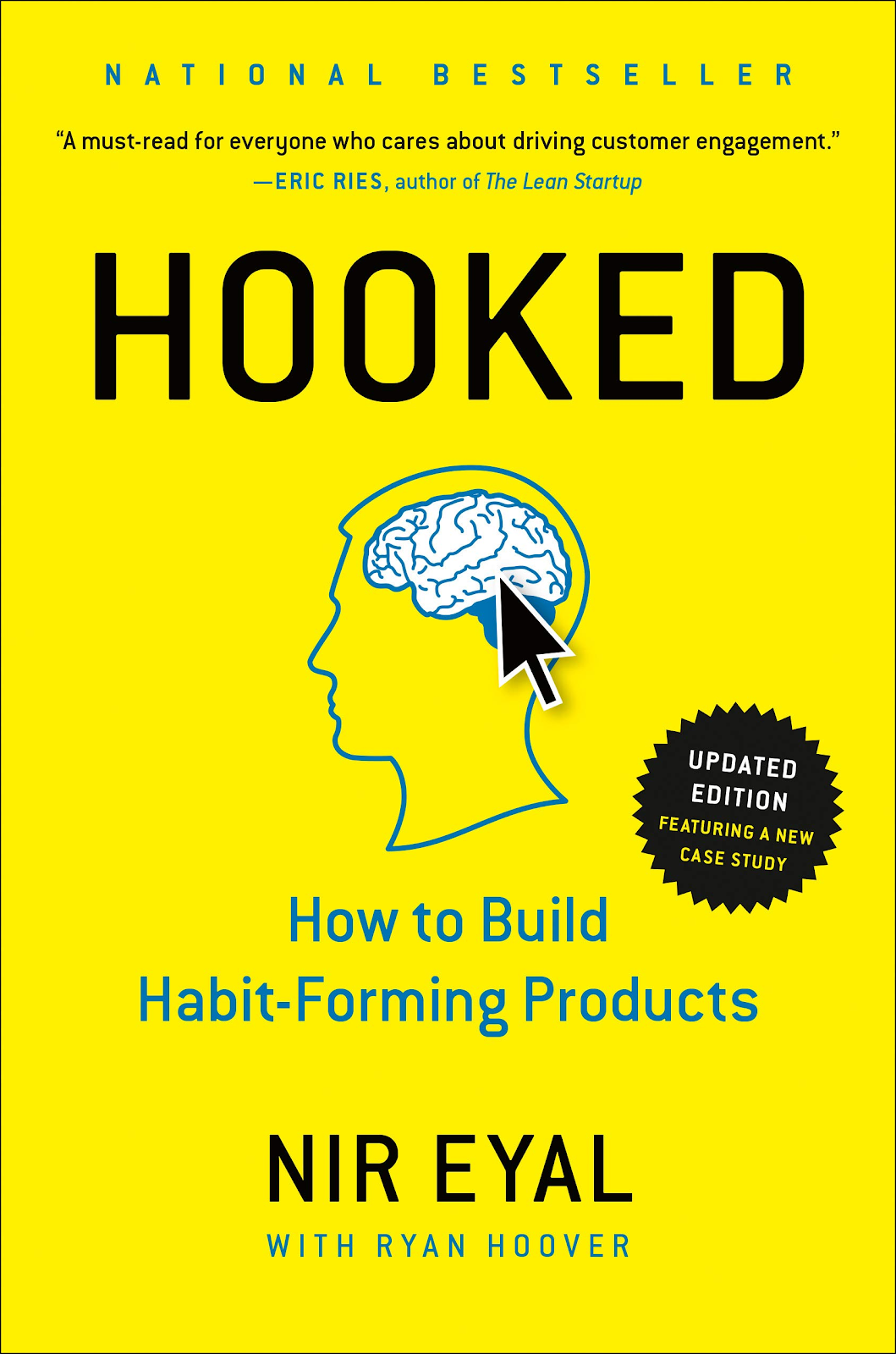
The Hook Model has four steps: trigger, action, variable reward, investment. It explains why users return to a product without being asked. For anyone building a product or designing a content strategy around retention — not just acquisition — this is mandatory reading.
The framework applies directly to email sequences, app onboarding, and community mechanics. I’ve used it to evaluate whether a product feature actually builds habit or just novelty.
3. Buyology: Truth and Lies About Why We Buy by Martin Lindstrom
Martin Lindstrom started his first advertising agency at 12 years old. He has since become one of the most cited branding consultants in the world, with his work featured in the Wall Street Journal, The Economist, Forbes, and Harvard Business Review.
Buyology draws on a three-year neuromarketing study with 2,000 volunteers across multiple countries. Lindstrom asked them to react to ads, logos, product packaging, and brand triggers — and then ran brain scans. The results disprove a lot of what marketers assumed about what actually drives purchase.
The biggest takeaway: the conscious reasons people give for buying things are frequently not the real reasons. Understanding the subconscious layer matters more than perfecting your feature list.
4. DotCom Secrets: The Underground Playbook for Growing Your Company Online by Russell Brunson
Russell Brunson started his first online business while wrestling at Boise State. Within a year of graduating, he was doing seven figures from a home office. He co-founded ClickFunnels, one of the most widely used sales funnel platforms available.

The book’s central claim: when companies struggle with traffic or conversion, the real problem is usually not the traffic source or the page copy — it’s a broken funnel architecture. Brunson breaks down the funnel stages, the scripts that work at each stage, and how to engineer traffic that converts.
This one is tactical and opinionated. You won’t agree with everything, but the funnel-first mental model is worth the read.
5. Building a StoryBrand: Clarify Your Message So Customers Will Listen by Donald Miller
Donald Miller is the CEO of StoryBrand. He has worked with thousands of business leaders annually on brand messaging. His books collectively spent over a year on the New York Times Bestseller list. Clients include Intel, Pantene, and Steelcase.

The StoryBrand framework uses seven elements of story structure to help any company simplify and clarify its message. The central insight: customers don’t buy the best product, they buy the product they can most clearly understand. If your homepage requires effort to parse, you’re already losing.
This is the book I recommend first to any founder who says “we have a great product but people just don’t get it.” The problem is almost always the message, not the product.
6. Influence: The Psychology of Persuasion by Robert Cialdini
Dr. Robert Cialdini holds a Ph.D. from the University of North Carolina and has held visiting scholar positions at Stanford’s Graduate School of Business. He is CEO and President of Influence at Work. His clients include Microsoft, Google, Coca-Cola, and NATO.
His books are on the Fortune Magazine list of the 100 best business books of all time.

Cialdini’s six principles — reciprocity, commitment/consistency, social proof, authority, liking, and scarcity — remain the most empirically grounded framework for understanding why people say yes. A 2021 expanded edition added a seventh principle (unity). The research behind the original six has held up for decades.
Every marketer, copywriter, and product designer should read this at least once. I re-read sections whenever I’m building an offer or redesigning a purchase flow.
7. Ogilvy on Advertising by David Ogilvy
David Ogilvy founded Ogilvy & Mather, one of the largest advertising networks in history. He is widely known as the “Father of Advertising.” His early clients included Rolls-Royce and Hathaway shirts; he was famously willing to terminate client relationships when quality standards weren’t met.
This book is older than most of what I read, but the underlying principles — headlines do 80% of the work, research beats intuition, long copy outperforms short copy when the prospect is engaged — remain accurate. The specifics on TV and print are dated; the discipline around clarity and the customer’s actual motivation is timeless.
8. Getting Everything You Can Out of All You’ve Got by Jay Abraham
Jay Abraham is founder and CEO of The Abraham Group. Over his career he has worked with more than 10,000 clients across dozens of industries, helping companies identify underutilized assets and hidden revenue opportunities.

Abraham’s core argument: most businesses are sitting on revenue they’re not capturing because they don’t see their existing assets — customers, relationships, distribution channels — at full value. The book outlines tactics for increasing customer lifetime value, referral rates, and transaction frequency before spending a dollar on new acquisition.
This reframe — stop optimizing for leads, start optimizing for the value already in your funnel — is one I’ve applied directly to content marketing and conversion work.
9. The 22 Immutable Laws of Marketing by Al Ries and Jack Trout
Al Ries pioneered the concept of positioning in marketing, co-authoring the foundational “Positioning Era” series in Advertising Age in 1972. Since 1994, he has run Ries & Ries consulting with his daughter Laura. Jack Trout was a co-founder of positioning theory and ran Trout & Partners until his passing in 2017.

The book distills their decades of experience into 22 sharp laws — the Law of Leadership (it’s better to be first than better), the Law of the Category (if you can’t be first, create a new category), and so on. Some examples are dated, but the strategic logic holds. It’s a useful antidote to the “more features, better product” trap.
10. Contagious: Why Things Catch On by Jonah Berger
Jonah Berger is a professor at the Wharton School at the University of Pennsylvania and one of the most cited researchers on social influence and word-of-mouth dynamics. His work has appeared in the Wall Street Journal, Harvard Business Review, and The New York Times.

Contagious answers a specific question: why do some ideas, products, and stories spread while others don’t? Berger’s STEPPS framework (Social Currency, Triggers, Emotion, Public, Practical Value, Stories) gives a repeatable lens for designing shareable content.
In 2026, when organic reach is expensive and AI-generated noise is everywhere, engineering genuine word-of-mouth matters more than ever. The STEPPS model is as applicable to a viral short-form video as it was to a water-cooler conversation. I’ve used it to audit TikTok and social content strategy more than once.
If these suggestions were useful, you might also want to look at:
- Growth hacking stories you should learn from
- Take your business to the next level with these great conversion tips
- Digital marketing fundamentals
Marketing Books — 2026 FAQ
Are these marketing books still relevant in 2026?
Yes, with one caveat: the strategic frameworks inside these books (persuasion psychology, story structure, habit loops, positioning theory) are durable because they’re grounded in how humans think and make decisions — not in channel mechanics. The channel examples will feel dated in some cases (especially anything referencing pre-2020 media costs), but the mental models are worth the translation effort.
Which book should I read first if I’m starting a company?
Building a StoryBrand by Donald Miller. Most early-stage companies fail at messaging, not product. Getting the clarity framework right early means every piece of content, every sales conversation, and every landing page you build afterward is aimed at the same target. It’s a fast read and immediately applicable.
Do I need different books for B2B vs. B2C marketing?
The books on this list apply to both, but they land differently. Influence and Contagious skew toward consumer psychology; DotCom Secrets and The 22 Immutable Laws apply cleanly to B2B funnels and positioning. Hooked is valuable for any product with a retention component — SaaS, consumer apps, or community platforms.
Is there a more recent book worth adding to this list?
Jonah Berger’s follow-up, The Catalyst: How to Change Anyone’s Mind (2020), is worth reading alongside Contagious if you’re doing any kind of behavior change marketing or enterprise sales. It focuses on reducing resistance rather than increasing push — a useful complement to Cialdini’s persuasion framework.
Related reading:
- Must-try content marketing trends
- How to improve your ecommerce conversion rate
- Digital marketing fundamentals
The shorter version
If you’re reading this because the workflow it describes is eating your week, that’s the kind of loop I build AI agents for. Two build slots open at a time.
What changed in 2026
The fundamentals in this post still hold — Ansoff, BCG, integrated marketing, land-and-expand, NYOP, TOMA frameworks are durable. What changed since the original publication is how the implementation surface looks in 2026:
- The distribution channels assumed in 2020-era marketing posts (organic Facebook reach, free Twitter virality, paid Instagram CPMs under $10) are gone or transformed. Re-cost any tactical recommendation against today’s CPMs.
- AI Overviews ate the top of the SEO funnel — TOFU content strategy from the 2022 era now needs a GEO layer (see the SEO updated note).
- Land-and-expand as a motion is healthier than ever in B2B SaaS; PLG → enterprise progression is the default path for almost any 2026 startup.
- Integrated marketing communication in 2026 means the brand voice shows up the same across paid, organic, AI-cited, podcast guesting, and the newsletter — because models like GPT-5 and Claude 4.7 are increasingly summarizing the brand, not just individual pages.
If you’re using this framework for a 2026 plan, the strategic skeleton is right; only the channel-mix data points need a fresh source.
Every Wednesday. 28,400+ operators. Zero fluff.
✓ Check your inbox — click the confirmation link to complete sign-up.
✓ You're subscribed!
✓ You're already on the list.
Related posts
Why Your Best-Ranking Pages Get Zero Clicks
I pulled my own Search Console data and found a page ranking position 8.9 with a 0.07% CTR. Here's what was actually wrong, and how I'd fix it.
GEOGEO for Multilingual Sites: Getting Cited in Every Language
Running GEO on a site that publishes in 13 languages taught me hreflang, llms.txt, and schema all behave differently than English-only advice assumes.
GEOHow to Add GEO to an Existing SEO Retainer
How an SEO agency adds real GEO work to an existing retainer — audit first, price it as its own line, and avoid relabeling the same deliverables.
Get the AI playbook in your inbox
Every Wednesday. 28,400+ operators. Zero fluff.
Check your inbox.
We sent you a confirmation email — click the link inside to complete your subscription. Check spam if you don't see it within a minute.
You're subscribed.
Welcome — the next edition lands in your inbox soon.
You're already on the list — look for it every Wednesday.