Competitive Advantage: Definition, Types, Examples

Every Wednesday. 28,400+ operators. Zero fluff.
✓ Check your inbox — click the confirmation link to complete sign-up.
✓ You're subscribed!
✓ You're already on the list.
Updated for 2026.
TL;DR: Competitive advantage is whatever lets you earn more, grow faster, or survive longer than rivals — Porter’s three generic strategies still apply, but data moats and distribution lock-in are now the dominant forms in the AI era.
Competitive advantage used to be a slow-moving concept — build a brand, own a patent, lock up distribution, and defend the moat for decades. That is still true at the highest level. But in 2026, with AI commoditizing execution at a pace nobody fully anticipated five years ago, the source of your moat matters more than ever. A feature that took a year to build can now be replicated in a weekend. What cannot be replicated overnight is proprietary data, a loyal audience, and network effects baked into the product.
I run AI agent systems for founders, and nearly every strategic conversation I have circles back to one question: what do we have that is genuinely hard to copy? This post answers that question — first with the durable framework, then with what the AI era adds to it.
Table of contents
Open Table of contents
What is a competitive advantage?
Competitive advantage is any attribute of a business that lets it consistently outperform its rivals — more customers, higher margins, faster growth, or all three. The advantage has to be durable: a one-quarter lead on a feature is not an advantage, it is a head start.
To build one, you need three things:
- Deep knowledge of your target customer. Not demographics — actual jobs-to-be-done, willingness to pay, and what annoys them about every existing solution.
- Honest assessment of the competition. Who is doing this now, who is well-funded and coming, and where are the structural gaps no one has filled.
- A credible reason why your edge persists. This is the hard part. Most teams skip it and end up with a USP that dissolves the moment a better-funded competitor shows up.
Read next: What is Green marketing and how you can do it
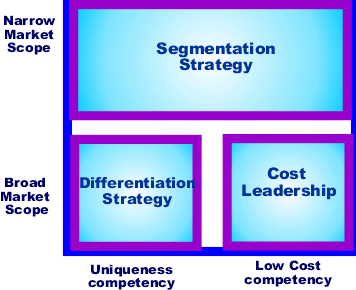
Porter’s three generic strategies
Michael Porter identified the foundational taxonomy in the 1980s, and it has aged well because it describes how you compete structurally, not what technology you use.
- Cost leadership: achieve the lowest delivered cost in your category and price to win volume. Amazon’s logistics infrastructure is the modern textbook case. In the AI era, companies that fine-tune their own models on proprietary workflows can drive unit economics no API-dependent competitor can match.
- Differentiation: offer something customers value enough to pay a premium for and cannot easily get elsewhere. Apple’s vertical hardware-software-services stack is the long-running example. In 2026, differentiation increasingly means taste and trust — because the underlying technical capabilities are available to everyone via API.
- Focus (market segmentation): pick a segment large enough to matter but specific enough that a generalist cannot serve it as well as you. This is actually stronger in the AI era: a narrow vertical dataset plus deep domain expertise beats a general model for most professional workflows.
Other sources of competitive advantage
Beyond the three generic strategies, any sustainable edge qualifies. Here are the ones that matter most in 2026:
- Brand and trust: customers pay a premium and extend the benefit of the doubt to brands they recognize and trust. This takes years to build and is almost impossible to copy quickly — making it one of the most durable moats. Effective brand strategies compound over time.
- Network effects: the product becomes more valuable as more people use it. WhatsApp, LinkedIn, and Figma all have this. In 2026, AI products with network effects are rare but potent — shared prompt libraries, collaborative agent workflows, and multi-sided data marketplaces are early examples.
- Data moats: proprietary training data or inference-time data that competitors cannot easily acquire. This is the new IP. A legal tech platform with ten years of case outcomes, or a healthcare app with longitudinal patient data, can train models that no startup with the same architecture can match from a standing start.
- Distribution lock-in: owning the channel is often more valuable than owning the product. A newsletter with 200 k engaged subscribers, a podcast with a loyal niche audience, or a channel partnership that delivers warm leads exclusively — these are compounding distribution moats. AI Overviews and LLM-cited content are adding a new layer: being the source models reference is a distribution moat in its own right.
- Switching costs: the harder it is for a customer to leave, the more durable the advantage. ERP systems, payroll platforms, and deeply integrated developer tools all benefit. In the AI era, teams that build custom agents on top of your platform create switching costs that dwarf anything a traditional SaaS product could generate.
- Intellectual property: patents, trade secrets, and proprietary algorithms. Still relevant, particularly in hardware, pharma, and industrial software where the innovation cycle is long enough to matter.
- Operational excellence: processes, culture, and execution speed that compound over time. Amazon’s logistics, Toyota’s manufacturing system, and Stripe’s developer experience are all operational moats dressed up as product features.
- Talent and know-how: specific expertise concentrated in a team. In the AI era this is narrowing to: people who can design agentic systems that actually work in production, and domain experts who can supervise AI output in high-stakes contexts.
- Reputation and quality: a track record of delivering is particularly powerful in categories where the cost of a bad outcome is high — legal, medical, financial, security.
- Capital and balance sheet: the ability to sustain price wars, R&D investment, or distribution subsidies that competitors cannot match. Most relevant at scale.
- Location: still underrated for physical or hybrid businesses. The only pickleball court in a dense neighborhood has a genuine location moat.
- Sustainability and values alignment: increasingly a decision factor for B2B procurement and talent acquisition, not just consumer goods.
What AI commoditizes — and what it does not
This is the framework shift that matters most in 2026.
AI commoditizes execution. Writing a solid first draft, generating a marketing image, building a CRUD app, summarizing a document, translating content — all of these are approaching zero marginal cost. If your competitive advantage rested on doing these things faster or cheaper than a human competitor, that moat is largely gone.
AI does not commoditize:
- Proprietary data (AI amplifies the value of unique data rather than substituting for it)
- Real relationships and trust
- Taste and editorial judgment
- Distribution audiences you have built over years
- Domain expertise required to supervise or verify AI output in high-stakes contexts
- Network effects baked into a product
The practical implication: founders and operators should audit their supposed moats and ask honestly whether a well-funded team with GPT-6 access and a six-month runway could replicate it. If yes, the moat is shallow. If no, understand precisely why not — that is your real competitive advantage.
Competitive advantage examples
1. Amazon

Amazon’s moat is not a website — it is a logistics infrastructure that took twenty-plus years and hundreds of billions of dollars to build. Same-day or next-day delivery in most major metro areas in the US is a structural advantage no new entrant can replicate at scale.
Prime membership is the lock-in mechanism: once customers condition themselves to two-day shipping, waiting five to seven days feels unacceptable. That behavioral lock-in drives higher purchase frequency and shields Amazon from price-only competition.
The 2026 layer: AWS and Bedrock give Amazon a second compounding moat in enterprise AI infrastructure. The data generated across retail, logistics, and cloud feeds model improvement in ways no pure-play AI startup can match.
Relevant: Read about some of the top competitors of Amazon here.
2. Meta

Meta’s core advantage is a multi-sided network effect spanning Facebook, Instagram, WhatsApp, and Threads — over three billion daily active users as of early 2026. The social graph is the moat: leaving means losing access to connections built over years.
The advertising business compounds this: the volume of behavioral data flowing through Meta’s platforms enables targeting precision that smaller ad networks cannot match, which attracts more advertisers, which funds more product development, which retains more users.
The 2026 update: Meta’s open-source AI strategy (Llama model family) is a calculated bet that commoditizing foundation models hurts closed-model competitors more than it hurts Meta, whose real moat is data and distribution — not model weights. This is a good example of using AI strategically to defend an existing moat rather than treating AI as the moat itself.
3. Apple

Apple’s moat has always been vertical integration: proprietary silicon, OS, software ecosystem, and retail experience designed as a single stack. No competitor offers exactly this combination. The result is a switching cost that is partly rational (ecosystem lock-in) and partly emotional (brand identity).
In 2026, Apple Intelligence — on-device AI processing tied to Apple Silicon — is extending this moat. Privacy-preserving AI that runs locally is a differentiator that cloud-first competitors structurally cannot copy without the hardware. Whether this becomes a dominant competitive advantage depends on execution, but the strategic logic is sound.
Bottom line
Any attribute that lets you earn more, grow faster, or survive longer than competitors can qualify as a competitive advantage. Porter’s three generic strategies — cost leadership, differentiation, and focus — are the durable framework. Data moats, distribution audiences, and network effects are the most defensible forms in 2026.
The exercise that actually matters: list what you think your moats are, then ask whether a well-funded competitor starting today could replicate each one in eighteen months. The items that survive that test are your real advantages. Build everything else around defending and extending them.
Did you learn some new things about competitive advantages? Next, check out these other posts:
- Understanding land and expand strategy and how to implement it
- The top growth hacking stories you need to know
Which type of competitive advantage do you think is hardest to copy in the AI era? Leave a comment letting me know.
Competitive Advantage — 2026 FAQ
Does AI eliminate competitive advantage, or just shift where it comes from?
It shifts where it comes from. AI commoditizes execution — writing, coding, design, analysis — which erodes advantages based purely on doing those things faster than humans. The advantages that survive or strengthen are data moats, distribution audiences, network effects, trust, and domain expertise needed to supervise AI output. If your moat is “we move faster,” that is probably not enough in 2026. If your moat is “we have ten years of proprietary data,” AI makes that more valuable, not less.
Is Porter’s framework still relevant in 2026?
Yes. The three generic strategies — cost leadership, differentiation, and focus — describe structural positions in a market, not tactics. Technology changes the tactics; it does not change the underlying logic that you need to be the cheapest, the most differentiated, or the most specialized to sustain above-average returns. What AI adds is that differentiation increasingly lives in intangibles (taste, trust, data, relationships) rather than product features, because features are easier to copy than ever.
What is a data moat and how do I build one?
A data moat is a proprietary dataset that trains better models or enables better decisions than anything a competitor can access from public sources. You build one by: (1) designing your product to capture behavioral or operational data as a byproduct of normal use, (2) obtaining the rights to use that data for AI training, and (3) actually training on it continuously so the advantage compounds. The moat is durable because the data is yours and grows over time. Note: data moats are only valuable if you actually use the data — many companies have the raw asset but fail to operationalize it.
How do small businesses compete when they cannot afford the same AI tools as large corporations?
The economics of AI tools actually favor small businesses more than the previous technology cycle. A solo operator with a $100/month AI stack can produce output that would have required a team of five in 2020. The real competitive question is not who has access to the tools — nearly everyone does — but who deploys them against a focused customer problem with a distinct point of view. Niche expertise, local relationships, and a specific audience are advantages that money and scale cannot easily override. Focus is the small business moat.
- A guide to cost leadership strategy
- Brand equity: what it is and how to build it
- Land and expand: how to implement it
This guide is part of alejandrorioja.com — written by Alejandro Rioja, who now builds AI agent systems for founders. Including the agent that keeps this site current. How it works →
What changed in 2026
The fundamentals in this post still hold — Ansoff, BCG, integrated marketing, land-and-expand, NYOP, TOMA frameworks are durable. What changed since the original publication is how the implementation surface looks in 2026:
- The distribution channels assumed in 2020-era marketing posts (organic Facebook reach, free Twitter virality, paid Instagram CPMs under $10) are gone or transformed. Re-cost any tactical recommendation against today’s CPMs.
- AI Overviews ate the top of the SEO funnel — TOFU content strategy from the 2022 era now needs a GEO layer (see the SEO updated note).
- Land-and-expand as a motion is healthier than ever in B2B SaaS; PLG → enterprise progression is the default path for almost any 2026 startup.
- Integrated marketing communication in 2026 means the brand voice shows up the same across paid, organic, AI-cited, podcast guesting, and the newsletter — because models like GPT-5 and Claude 4.7 are increasingly summarizing the brand, not just individual pages.
If you’re using this framework for a 2026 plan, the strategic skeleton is right; only the channel-mix data points need a fresh source.
Every Wednesday. 28,400+ operators. Zero fluff.
✓ Check your inbox — click the confirmation link to complete sign-up.
✓ You're subscribed!
✓ You're already on the list.
Related posts
How to Set Up SPF, DKIM, and DMARC for Business Email
Your business email lands in spam because three DNS records are missing. Here is how to check them, fix them in about an hour, and move DMARC to enforcement.
AI AgentsThe Claude Skill That Writes My Google Ads Copy
I built a Claude skill that pulls Google Ads data via GAQL, flags underperforming RSAs by CTR and CPA, and rewrites headlines inside Google's character limits.
EntrepreneurshipHow to Build a Productized Service: My Framework
The exact framework I use to turn one-off consulting work into productized services — defined scope, fixed price, repeatable delivery
Get the AI playbook in your inbox
Every Wednesday. 28,400+ operators. Zero fluff.
Check your inbox.
We sent you a confirmation email — click the link inside to complete your subscription. Check spam if you don't see it within a minute.
You're subscribed.
Welcome — the next edition lands in your inbox soon.
You're already on the list — look for it every Wednesday.