Top 3 Backlink Building Strategies in 2026

Backlinks still rank you on Google in 2026 — and the three strategies below still work. For AI engines, the equivalent currency is citations: ChatGPT, Perplexity, and Google AI Overviews don’t ‘rank’ sources, they cite them.
Every Wednesday. 28,400+ operators. Zero fluff.
✓ Check your inbox — click the confirmation link to complete sign-up.
✓ You're subscribed!
✓ You're already on the list.
Updated for AI Search (2026)
What’s new in this refresh: a section on how this strategy plays in AI search engines (ChatGPT, Perplexity, Google AI Overviews, Claude), a 4-block GEO scaffold, and a fresh FAQ.
Bottom line
Even if your written content is falling flat, you could find success via link exchanges and engagement with influential people in your field. Remember that you can also pay for links if things become tough.
Experts in search engine optimization (SEO) have sometimes confessed to using this method. Your backlinking efforts will be launched into orbit if you use the new tactics.
Building links may seem like a simple chore to the ordinary individual. However, this has to be considered seriously by SEO experts, as I said in my previous post on link prospecting.
High-quality link chances are difficult to come by, but your campaign will reap the benefits in spades when you do. As for me, I find link prospecting to be a tedious and time-consuming procedure.
However, if you really want to maintain your online success, this is likely your best option.
Table of contents
Open Table of contents
- Backlink Building Strategies
- Backlink Strategies: Why It Matters
- The Value of Monitoring your Backlinks
- Bottom line
- How backlink building works in AI search engines (ChatGPT, Perplexity, Google AI Overviews, Claude)
- FAQ — backlink building in the AI search era
- Where I’d take this next
- What changed in 2026
Backlink Building Strategies
Did you know that SEO experts think link-building is a good implementation approach?
You’ll find link-building tough if you’re unaware of which backlinking tactics work. The good news is that you may simultaneously utilize many tactics to increase backlinks and brand recognition.
Continue reading to find out how to implement the most efficient backlinking solutions. Even while backlinks are crucial to your SEO strategy, it’s not something you can do and forget.
Over time, backlinks may lose value, become bad, or obsolete. To maintain a high search engine position, it is necessary to seek new possibilities to build backlinks constantly.
To help you narrow down your options, I have included my top suggestions below.
1. SEO Backlinks: Mimicking your Competition
Identifying the sites that connect to your rivals is a major victory. If your competitors have backlinks, you can rest assured that they are on niche-relevant sites, making them valuable for SEO.
It’s possible to spend a lot of time doing this by hand, but free and commercial programs may help examine the backlink profile of your rivals.
Launch the tool, type in the rival’s URL, and choose check backlinks. Backlink data, such as totals, percentages, and more, will be generated when the tool completes its audit of the domain.
Imitating your rivals’ backlinks has several advantages, the most notable of which are listed below.
- Mimicking your rivals’ backlink profiles can also help you get connections from authoritative websites. Not only does the linking domain’s Domain Authority (DA) matter, but also its relevance.
- Getting the finest of the greatest backlinks isn’t always easy when guest blogging is your major backlink strategy. However, if you steal your rivals’ backlinks, you’ll have greater leeway to adjust to changing market conditions.
- Imitating your rivals’ backlink profiles may boost your search engine rankings. You may increase your platform’s exposure and even steal some of your rival’s customers.
2. Image-based link-building
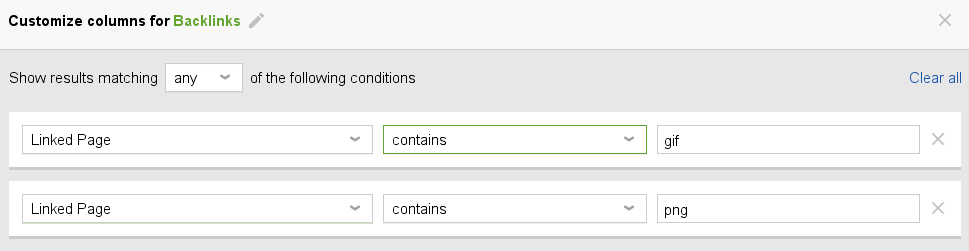
It makes sense that individuals would be most likely to click on a picture since it demands more of the reader’s attention and visual space. Creating and promoting visual content (graphics, infographics, product photographs, cartoons, etc.) may significantly increase inbound links.
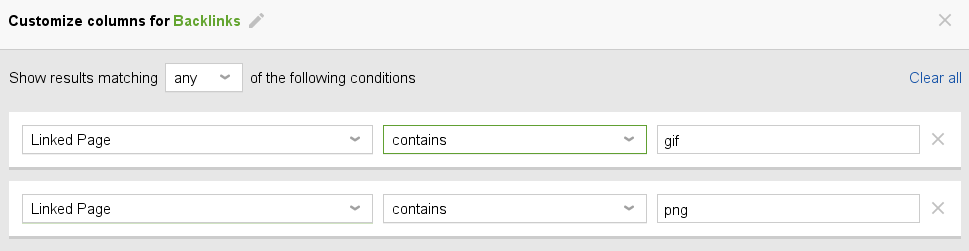
If you’re going to link to an image, make sure the picture’s host page gets the credit instead of the image directory. All traffic to image directories (those with file extensions like.gif,.png,.jpg, etc.) is wasted.
To determine whether any of your backlinks point to picture directories, put up filtering in your optimization tool to see whether the target URLs include picture formats.
If you notice any, consult the site owner to change the link with something which links to the webpage with the picture. Additionally, if you’re allowing them to include your picture on their website, they should be alright connecting to the proper area.
3. Create broken links
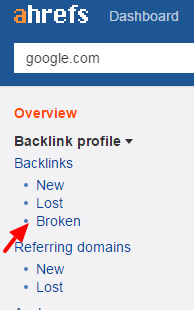
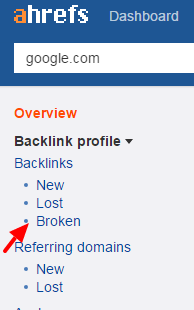
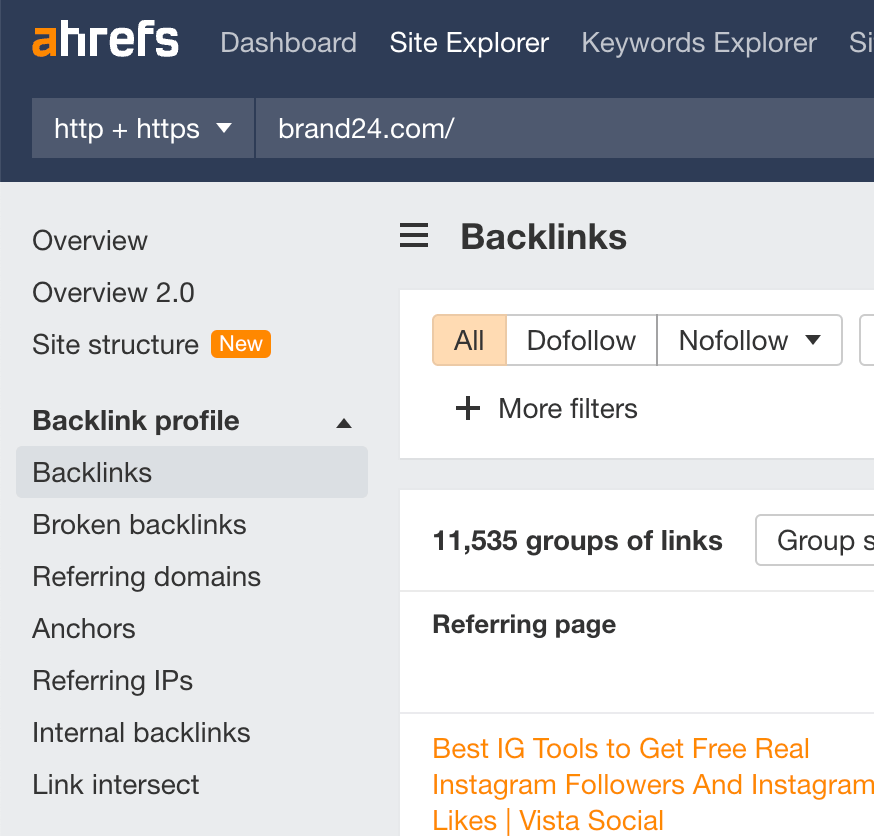
Do not waste time compiling every page; instead, check Ahrefs’ database for any dead links to your site. The process entails little more than entering your domain and selecting a link.
This backlink technique is a subtle method that undercuts your rivals, filling their obsolete shoes. The aim is to identify formerly useful linkages within your field that are now broken and then fill the void with new material.
Your best bet for discovering broken content links on your competitors’ web pages is to focus on their sites directly.
A broken link checker is useful for this purpose. Once you locate a broken link, run this URL via a backlink-checking program.
Use a backlink checker to see which sites have pointed to the broken file, or look for some SEO tools online. You would then approach the sites linked to the main article and offer your material in its place.
Backlink Strategies: Why It Matters
This is known as a backlink when an external website connects to yours. When a website provides a link to another website, it usually provides further information on a topic or provides support for that website.
Google will boost your site rankings if it sees this as evidence that it is an authoritative resource. Because of this, domain authority and Google page rank are influenced by the number and quality of inbound connections to your site.
A proportion of all clicks travel to the first Google search result. Therefore, it is in your best interest to rank as close to the top of the search results as possible to get the freest, organic clicks.
Google will see you as more credible as an authority if you have more inbound links. With credible inbound connections, you may benefit from the established authority of these other sites.
In addition to helping you rise in the ranks, this action also helps you. Remember this while you create your connection strategy.
Before submitting a link, check its quality using a website SEO tool. Higher search engine rankings result in more organic visitors.
To rank well and attract more visitors, you need a solid backlinking strategy as an element of your SEO campaign.
Which kinds of backlinks are the most beneficial?
There is no guarantee that you will get all of the search engine optimization benefits a backlink will have to offer simply because another website is referring to your own. Concentrating on acquiring high-quality inbound links is crucial, and you’ll see an increase in your ranking position.
1. They Originate from a Reputable Online Source
This has also been brought to Google’s attention. There is a notion referred to as domain authority, and Google considers it an important component when determining the amount of weight a link gives.
Links coming from websites with a high level of authority have more value in their voting than links from websites with a lower level of quality.
These connections are very difficult to get, but if you manage to acquire one, it will place you on the map.
2. Your Anchor Text is Optimized to Incorporate your Desired Keyword
Anchor text refers to the portion of a link shown to the user and may seem a little too technical for others, so here’s a breakdown.
When Google crawls a page, it scans the HTML code, and one of the things it looks for is links that are enclosed in a tag. There is the URL to which the link is pointing, as well as the text that is being connected.
You’ll notice that each time there’s a link in an article, the relevant text will be highlighted in blue. The blue text you see there is the anchor text.
The anchor text that other websites use when connecting to you is just as important as the website that links to you in the first place. Use the keyword throughout the page’s content to improve your page’s search engine rankings for your primary term.
3. The Content That Links to you is Associated with the Content that you Produce
If the page that links to your website has material that is in no way connected to what you do, then the benefits it brings to your website are limited.
As a consequence of this, the value of that relationship to us would be relatively modest. It is possible that rankings will not change at all as a result of this.
4. That’s Because it’s a “Dofollow” Link
If the link to your website is a no follow link, it is not beneficial to your search engine optimization (SEO). This is perhaps the most crucial quality of all the characteristics.
Without passing any SEO value, sometimes known as “link juice,” this signals search engines to disregard the linked website. Fortunately, all URLs on the internet are do-follow by default.
The following are some prominent exceptions:
- Comments sections
- Internet and social media resources
- URLs of forum posts
- Links in which the author has expressly designated them as “no follow”
The Value of Monitoring your Backlinks
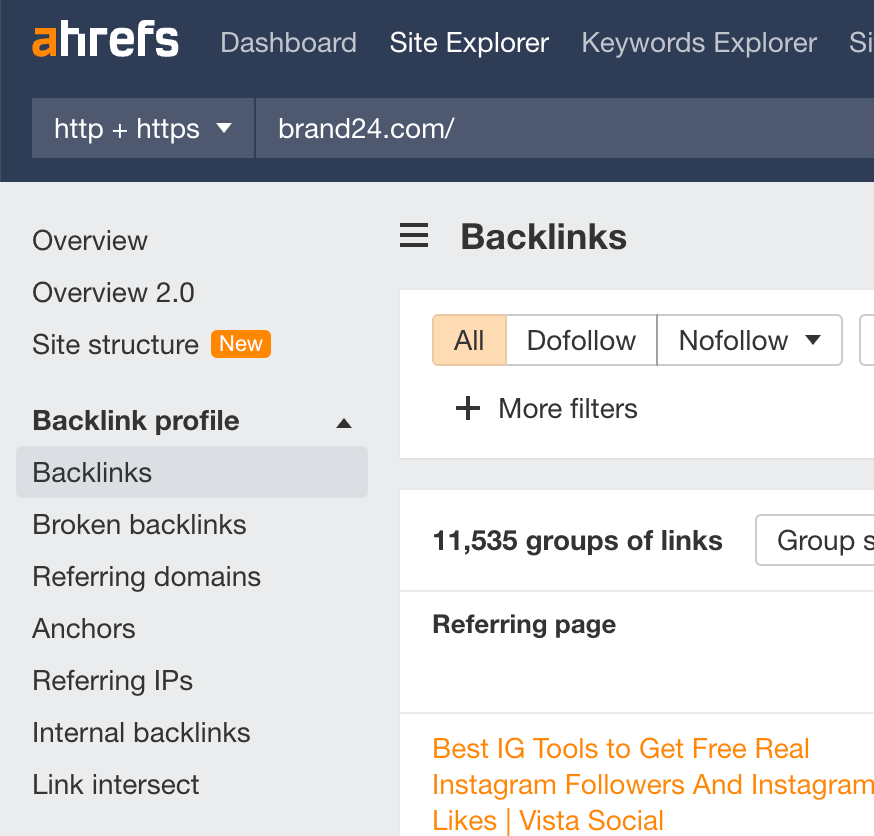
The vast majority of individuals invest their time and resources into acquiring new connections. Still, they do not monitor the status of those links.
How would you know whether one should continue building backlinks or take a break if you do not monitor them? You could have more than 800 links to your website right now. However, if you check it again in three to six weeks, you might find that some of those connections have disappeared.
You should maintain a record of your backlinks for the following reasons:
- Your ability to influence which blogs and authoritative sites link to you is limited.
- It is quite simple for the site operators to delete your link from any post or reference page on their domain. Also, they are not required to provide you with any advance notice.
Bottom line
Backlinks are useful for search engine optimization (SEO) since they serve as a “confidence vote” from one website to another.
Simply put, search engines will consider the number and quality of inbound links to your site as evidence that other people find and value your material. Search engines will give more weight to a page or site in a SERP if it receives a high number of inbound links from other credible sources.
Therefore, getting these backlinks may improve a site’s search engine rankings and traffic.
Do you want to read more about backlinks, SEO-related articles, and instructions on how to create one? Check out any of these posts!
- 11 Simple On-The Best SEO Guide For 2022
- The Best SEO Guide For 2022
- How To Do Local SEO: Top Tips, Strategies, And Tools 2022
How backlink building works in AI search engines (ChatGPT, Perplexity, Google AI Overviews, Claude)
Classic backlinks still pass authority that AI engines respect — a page with strong backlinks is more likely to be cited by an LLM than the same page without them. So the three strategies below are not obsolete, they’re prerequisite. What’s new is a parallel KPI: how often is your page cited inside an AI answer, and from which prompts?
Concretely, in 2026 I’m tracking two things side-by-side for every pillar post: backlink count (Ahrefs) and AI-citation rate (manual sampling across ChatGPT, Perplexity, Google AI Overviews, Copilot). Pages that win on both compound fastest. Pages that have strong backlinks but no AI citations usually need a structural fix — TL;DR, FAQ, schema — not more outreach.
The 4-block GEO scaffold for backlink building
- Lead with a TL;DR. 2-4 sentences at the top of the post that answer the head query directly. AI Overviews and Perplexity preferentially cite this block.
- Add a numbered step-by-step section. Generative engines extract clean ordered lists into their answers more reliably than prose.
- Close with an FAQ. Use the literal phrasing of questions people actually ask in your niche; mark up with FAQPage schema.
- Cite primary sources. Link to Google’s own AI Overviews documentation, OpenAI’s structured-data guidance, and Anthropic’s content-quality posts. LLMs trust pages that cite the model providers themselves.
Internal reading on AI SEO + GEO
If you’re building this into your stack, also read: the full SEO guide for 2026, What is SEO?, 17 white-hat SEO techniques, the schema markup tutorial.
FAQ — backlink building in the AI search era
Are AI citations as valuable as backlinks in 2026?
Different and complementary. Backlinks pass authority and drive direct referral traffic. AI citations drive in-answer brand visibility and high-intent click-throughs. The most valuable sites have both. Optimizing only for one and ignoring the other leaves traffic on the table.
How do I check if Perplexity / ChatGPT is citing my site?
Manual sampling is still the most reliable method in 2026. Pick 30-50 head queries from your niche, run them through each engine weekly, log which sources are cited. Tools like Profound and Athena are starting to automate this; the manual baseline is still worth running.
Do nofollow links matter for AI engines?
Indirectly — AI engines crawl them like any other link to discover content, but they don’t pass the same trust signal that dofollow links do for classic ranking. For pure GEO purposes, the value of any link is in the discovery/citation signal, not the link-equity calculation Google uses.
Where I’d take this next
If you operate inside any of the loops above, I build custom AI agent systems that automate them. The whole site you’re reading is one — here’s the stack.
What changed in 2026
SEO in 2026 is unrecognizable from the 2020-era playbook. Three shifts that matter for anything written before mid-2024:
- AI Overviews are the new SERP zero position. Google’s AI Overviews default to roughly 60% of US informational queries, eating most “what is” / “how to” CTR. Optimizing for citation inside the AI Overview is now as important as ranking #1.
- GEO (Generative Engine Optimization) is the working term for cross-engine optimization — getting cited inside ChatGPT, Perplexity, Claude, and Gemini answers. ~12% of high-intent commercial queries in late 2025 sample studies showed a direct-citation flow from these engines (vs. zero pre-2023).
- E-E-A-T (now E^3-A-T, Experience + Expertise + Establishment + Authoritativeness + Trustworthiness) continues to be the framing Google uses internally — “Establishment” was the 2024 addition emphasizing brand-level signals.
Tool landscape (2026): Ahrefs and Semrush both shipped Generative Engine tracking. Surfer SEO + the Topical Authority crowd added GEO scoring. Screaming Frog still the standard crawler. AlsoAsked, Keyword Insights, and Frase shifted heavily into AI-Overview snippet engineering.
If this post predates May 2024, treat its core advice as the Google-search baseline and layer the GEO playbook on top.
Every Wednesday. 28,400+ operators. Zero fluff.
✓ Check your inbox — click the confirmation link to complete sign-up.
✓ You're subscribed!
✓ You're already on the list.
Related posts
Why Your Best-Ranking Pages Get Zero Clicks
I pulled my own Search Console data and found a page ranking position 8.9 with a 0.07% CTR. Here's what was actually wrong, and how I'd fix it.
GEOGEO for Multilingual Sites: Getting Cited in Every Language
Running GEO on a site that publishes in 13 languages taught me hreflang, llms.txt, and schema all behave differently than English-only advice assumes.
GEOHow to Add GEO to an Existing SEO Retainer
How an SEO agency adds real GEO work to an existing retainer — audit first, price it as its own line, and avoid relabeling the same deliverables.
Get the AI playbook in your inbox
Every Wednesday. 28,400+ operators. Zero fluff.
Check your inbox.
We sent you a confirmation email — click the link inside to complete your subscription. Check spam if you don't see it within a minute.
You're subscribed.
Welcome — the next edition lands in your inbox soon.
You're already on the list — look for it every Wednesday.